
Currency risk in personal finance is the chance that a rate move changes your costs, savings or debts.
It is measured in the currency you earn.
Say you earn VND but owe tuition, loans or family support in USD.
A weaker dong quietly raises those bills. Nothing in your budget changes, yet you pay more.
This guide shows how to measure that exposure, split an emergency fund and budget with a buffer.
It ends with a one-page plan. Every rate used is an assumption.
Key takeaways
- Currency risk appears when you earn in one currency and spend, save or owe in another.
- The extra cost of a rate move equals the foreign amount times the rate change.
- Budgeting at a buffered rate turns surprises into small surpluses instead of shortfalls.
- Matching savings to the currency of future spending reduces risk more than trying to predict exchange rates.
- Splitting large conversions into scheduled tranches limits regret without requiring a market forecast.
What is currency risk in personal finance?
Currency risk is the gap between the currency you earn and the currency you owe.
When the rate moves, one side of your budget changes value. The other side does not.
Investor-education materials usually discuss it for foreign investments.
The household version is simpler. You hold or owe two currencies, and you do not control the conversion price.
The risk runs both ways. A stronger dong lowers USD bills in VND terms; a weaker dong raises them.
Planning aims to survive the unfavorable direction.
Exposure versus volatility
Volatility is how much a rate moves.
Exposure is how much of your money sits on the wrong side of that move.
You cannot control volatility. You can control exposure.
Who is exposed?
Anyone whose earning and spending currencies differ is exposed.
In Vietnam, the most common cases fall into a few clear groups.
- Parents paying overseas tuition. Fees are billed in USD, while salaries arrive in VND.
- Borrowers with USD loans. Repayments are fixed in USD, so a weaker dong raises every installment.
- Foreign professionals paid locally. A fictional Mr. Daniel earns VND but repays a mortgage back home.
- Families supporting relatives abroad. Regular transfers carry the same mismatch as tuition, on a smaller scale.
- Savers planning a future move. Relocating or retiring abroad creates a large future USD need.
The reverse case also exists.
Someone paid in USD who spends in VND is exposed to a stronger dong. It shrinks local purchasing power.
For a broader view of the forces behind exchange rates, see our guide to Vietnam’s main economic indicators.
How much can an exchange-rate move cost you?
The cost of a rate move is easy to compute.
You need two inputs: your monthly foreign-currency obligation and the rate you budgeted at.
Extra cost (VND) = Foreign-currency amount × (New rate − Budget rate)
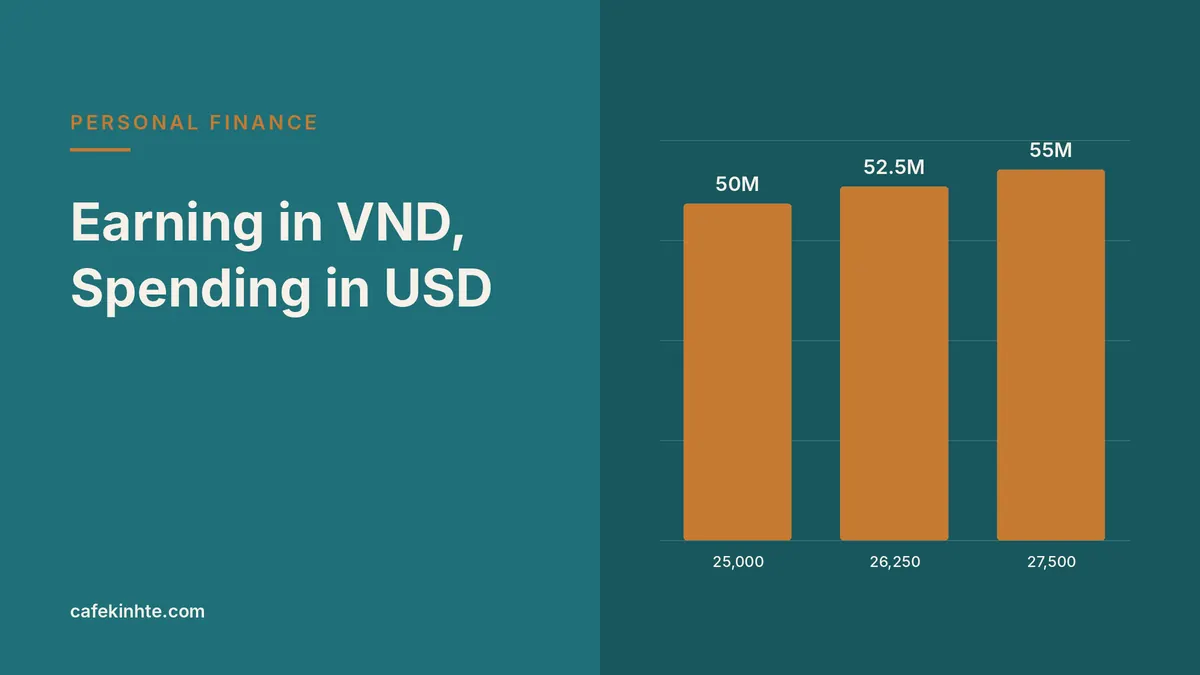
Consider Ms. Lan, a fictional manager in Hanoi. She takes home 90,000,000 VND per month.
Each month she sends USD 2,000 for her son’s tuition and living costs abroad.
She budgets at an assumed 25,000 VND/USD.
The table tests two assumed weaker-dong scenarios: a 5% move to 26,250 and a 10% move to 27,500.
| Scenario (assumed rate) | Rate change | Monthly USD 2,000 in VND | Extra cost per month (VND) | Extra cost per year (VND) | Share of take-home pay |
|---|---|---|---|---|---|
| Base: 25,000 VND/USD | 0.0% | 50,000,000 | 0 | 0 | 55.6% |
| Moderate: 26,250 VND/USD | 5.0% | 52,500,000 | 2,500,000 | 30,000,000 | 58.3% |
| Severe: 27,500 VND/USD | 10.0% | 55,000,000 | 5,000,000 | 60,000,000 | 61.1% |
In the moderate case, Lan pays 2,000 × (26,250 − 25,000) = 2,500,000 VND more each month.
That is 30,000,000 VND (≈ USD 1,200 at 25,000, assumed) per year.
In the severe case, the extra cost doubles to 5,000,000 VND per month.
That is 60,000,000 VND (≈ USD 2,400 at 25,000, assumed) per year.
A 10% rate move raises the obligation by 10%, but her income stays flat.
Her other VND spending must absorb the whole shock.
Run your own stress test
List every USD obligation for the next 12 months and add them up.
Multiply that total by 5% and by 10% of your budget rate. Those two numbers are your stress-test costs.
How do you build an emergency fund across two currencies?
An emergency fund should cover essential costs in the currencies those costs are paid in.
Holding everything in one currency leaves the other part of your needs exposed.
Lan’s essential monthly costs are 35,000,000 VND for her household plus USD 2,000 for her son.
She targets six months of cover.
| Component | Monthly need | Months covered | Fund target | VND equivalent (25,000 VND/USD, assumed) |
|---|---|---|---|---|
| Household costs in VND | 35,000,000 VND | 6 | 210,000,000 VND | 210,000,000 |
| Tuition and living costs in USD | USD 2,000 | 6 | USD 12,000 | 300,000,000 |
| Total | 510,000,000 |
The total of 510,000,000 VND is about USD 20,400 at the assumed rate.
The split matters more than the total.
Suppose the whole fund sat in VND and the rate moved to 27,500.
Replacing USD 12,000 would then cost 330,000,000 VND, and her cover would shrink.
Keep it liquid and simple
An emergency fund exists for access, not returns.
Each currency portion should be reachable within days, without penalties, in plain, low-risk deposits.
How do you budget with a conversion buffer?
A conversion buffer means budgeting foreign-currency costs at a rate slightly worse than you expect.
It builds a margin into the plan before any move happens.
Buffered budget rate = Expected rate × (1 + Buffer %)
Lan chooses an assumed 5% buffer. Her budget rate becomes 25,000 × 1.05 = 26,250 VND/USD.
She now budgets 52,500,000 VND per month for her USD costs.
Suppose her actual conversion rate turns out to be 25,500, also assumed.
Each month she spends 51,000,000 VND and keeps 1,500,000 VND as surplus.
Over 12 months, that surplus reaches 18,000,000 VND (≈ USD 720 at 25,000, assumed).
She can move it to a rate-shock reserve rather than spending it.
How large should the buffer be?
Base it on how far rates moved over past periods as long as your horizon.
A longer horizon or a more volatile pair needs a wider buffer.
Review the buffer once a year.
If obligations grow, the same percentage covers a larger amount. Check your VND budget can still carry it.
How do you match savings to the currency of future spending?
Matching means holding savings for a goal in the currency the goal will be paid in.
It removes the conversion step that creates the risk.
Lan knows next year’s tuition is USD 24,000.
VND savings earmarked for it stay exposed until converted. Savings already held in USD for that bill do not.
Long-term VND goals, such as a home in Hanoi or retirement in Vietnam, are best kept in VND.
Converting them into USD would create a new mismatch.
Use a goal-by-goal map
- List each goal. Note its amount, due date and the currency it will be paid in.
- Tag the savings. Assign each existing balance to a specific goal.
- Flag the gaps. Any goal funded in a different currency from its bill is an open exposure.
Matching does not require predicting rates.
It aligns the currency of your assets with that of your liabilities. Portfolio managers use the same principle.
How do you convert large amounts without trying to time the market?
Split a large conversion into equal tranches on a fixed schedule.
This approach accepts an average rate instead of betting on a single moment.
Lan needs USD 24,000 for next year’s tuition. She converts USD 6,000 each quarter.
The quarterly rates below are assumptions for illustration, not forecasts.
| Quarter | Assumed rate (VND/USD) | USD converted | VND paid |
|---|---|---|---|
| Q1 | 25,000 | 6,000 | 150,000,000 |
| Q2 | 25,800 | 6,000 | 154,800,000 |
| Q3 | 25,400 | 6,000 | 152,400,000 |
| Q4 | 26,200 | 6,000 | 157,200,000 |
| Total | 25,600 average | 24,000 | 614,400,000 |
Her average rate is 614,400,000 ÷ 24,000 = 25,600 VND/USD.
Converting everything in Q1 would have cost 600,000,000 VND. Converting everything in Q4 would have cost 628,800,000 VND.
The staged plan lands between the best and worst single dates.
The 28,800,000 VND spread between those extremes is the regret that staging helps avoid.
Set the schedule in advance
Fix the dates and amounts before you start, then follow them.
Changing the plan based on headlines turns a discipline into a guessing game.
How do you track and rebalance your currency mix?
Your currency mix is the share of your savings held in each currency.
Track it on a fixed date, such as each quarter, using one consistent reference rate.
USD share = USD savings in VND ÷ (VND savings + USD savings in VND)
Lan holds 300,000,000 VND and USD 8,000.
At 25,000 (assumed), the USD portion equals 200,000,000 VND. Her USD share is 40.0%, matching her target.
If the rate moves to 27,500 (assumed), the USD portion is worth 220,000,000 VND.
Her USD share rises to 42.3% without any new saving.
She sets a tolerance band of five percentage points around her 40% target.
A drift to 42.3% stays inside the band, so no action is needed.
When to act
Act only when the mix leaves its band or when a goal changes.
Rebalancing with new monthly savings is usually easier than converting existing balances.
If you hold investments as well, the same idea applies.
Our investing section covers diversification and portfolio basics in more depth.
What goes on a one-page currency plan?
A one-page plan turns the steps above into a short document you can review in minutes.
It keeps decisions consistent when rates move quickly.
- Exposure list. Every foreign-currency obligation for the next 12 months, with amounts and due dates.
- Budget rate and buffer. The expected rate, the buffer percentage and the resulting buffered rate.
- Stress-test results. The extra annual cost under a 5% and a 10% unfavorable move.
- Emergency fund split. Months of cover and the target amount in each currency.
- Goal-currency map. Each goal, its payment currency and the savings assigned to it.
- Conversion schedule and mix rules. Tranche dates and amounts, the target USD share and its tolerance band.
Review the page every quarter and after any major life change.
Update the numbers, not the rules, unless your goals themselves have changed.
More planning tools are available in our personal finance section.
Common mistakes
Most currency problems in household budgets come from habits, not extreme rate moves.
These patterns cause the most damage.
- Budgeting at today’s rate. A budget with no buffer turns any unfavorable move into an immediate shortfall.
- Keeping the whole emergency fund in one currency. Part of your essential costs stays exposed.
- Trying to time a big conversion. Waiting for a better rate can force a rushed conversion.
- Ignoring loan repayments. A fixed USD installment is a long-term exposure, whatever the interest rate.
- Mixing goals and currencies. Without a goal-currency map, savings drift into the wrong currency.
- Using inconsistent rates. Changing reference rates makes your mix appear to move when it has not.
Frequently asked questions
Is currency risk only a concern for investors?
No. Any household with income in one currency and costs in another carries it.
Tuition, loan payments and family transfers create exposure even without investments.
How big should my conversion buffer be?
Many households start with 3% to 5% for a one-year horizon and widen it for longer ones.
Base it on past rate moves, not forecasts.
Should I keep all my savings in USD to be safe?
Not necessarily. If most future spending is in VND, holding everything in USD creates the opposite exposure.
Match each portion of savings to the currency of its goal.
How often should I review my currency plan?
Quarterly works for most people.
Also review it after a job change, a new loan, a tuition increase or a currency change.
Sources
- Glossary: Currency Risk – U.S. Securities and Exchange Commission, Investor.gov (accessed Oct 2026)
- International Investing – U.S. Securities and Exchange Commission, 2012
- Exchange Rate Calculations – CFA Institute, 2026
- What Is the Role of Exchange Rates? – European Central Bank, 2026
- Triennial Central Bank Survey of Foreign Exchange and OTC Derivatives Markets – Bank for International Settlements, 2025
- Exchange Rates and Economic Fundamentals: A Framework for Analysis – International Monetary Fund, 1994
Read next
- Macroeconomics: how the economy shapes your money
- How to read Vietnamese company financial statements
- Corporate finance basics for managers
This article is for general education, not financial, investment, legal or tax advice.
All exchange rates, incomes, costs and scenarios are assumptions for a fictional person.
 Vietnam’s Key Economic Indicators Explained: GDP, CPI, PMI and the Exchange Rate
 How to Read a Vietnamese Company’s Financial Statements: A Guide for Foreign Investors